DEPARTMENT

Cultural Fault Lines

Where tradition collides with ideology—and the cracks begin to show.
This category explores the cultural conflicts shaping daily life, from institutions and norms to identity and belief, without slogans or sanctimony.

Why We Don’t Read (Yet) — and How to Start Again

We live in a strange cultural moment: books have never been more accessible, yet reading has never been more neglected. National surveys show a steep, decades-long decline in reading for pleasure, with some reports estimating a nearly 40 percent drop in daily leisure reading over the past twenty years. Another study from the American Academy of Arts & Sciences found that the percentage of adults who read at least one book outside of work each year has fallen steadily as well. These numbers confirm what many already feel in their own lives: people who once devoured novels now struggle to finish a chapter, and countless purchased books remain untouched. The question isn’t whether reading has declined—but why.

Read More »

Samantha Fulnecky’s Case IS Viewpoint Discrimination, Plain and Simple

Look no further than University of Oklahoma for the newest culture war plaguing social media. Last week, the Turning Point USA chapter at OU published an X thread following the experience of Samantha Fulnecky, a third-year psychology student whose 650-word response to a gender-related article received a 0/25. Fulnecky’s response–utilizing her own religious convictions and citations–was met with comments from her instructor reading, “I am deducting point[s] for you posting a reaction paper that does not answer the questions for this assignment, contradicts itself, heavily uses personal ideology over empirical evidence in a scientific class, and is at times offensive.” Certainly, it didn’t help that the instructor who failed Samantha Fulnecky uses she/they pronouns. Quick summary on the assignment: The article she and her peers were asked to review in this developmental psychology course dealt with gender typicality, peer relations, and mental health. In Fulnecky’s response paper, she reflected on a key phenomena taking place in higher education: “It is frustrating to me when I read articles like this and discussion posts from my classmates of so many people trying to conform to the same mundane opinion, so they do not step on people’s toes.” She continued, “I strongly disagree

Read More »
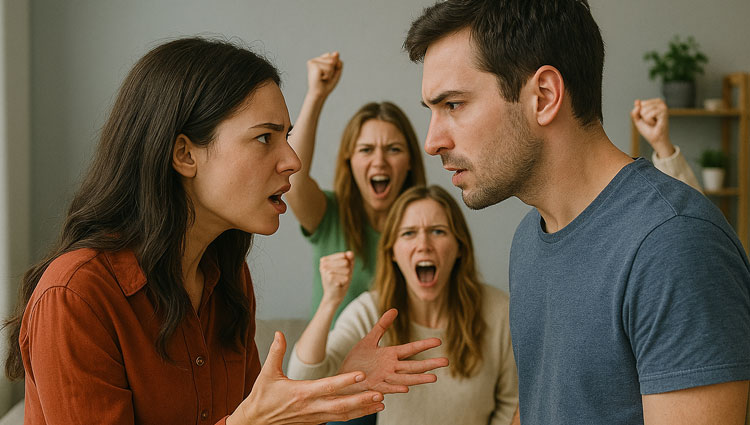
boyfriend and girlfriend arguing

Sorry, But Having a Boyfriend Isn’t Fascism: Love is the New Counterculture

Why, how, what? Straight women in happy, loving relationships tiptoe through life, especially in urban areas, as if every straight couple walking around SOHO holding hands is personally responsible for the housing crisis and grocery store prices. It’s now safer to hide your partner than celebrate them, better to be miserable than fulfilled in a loving relationship.

Read More »

Expiration-Date Love: Matchmaking in the Ivy League

Dating is no longer a slow unfolding of two lives intersecting but an optimized pairing system, curated for efficiency and filtered for personal convenience. In this framing, people become selections, and intimacy is a checkbox away.

Read More »

Power, Media, and the Animal Industrial Complex: An International Conversation with Núria Almiron

“The animal industrial complex is a very useful term because it captures the complexity of the exploitation humans have created for non-human animals. It points to a network rather than simply a collection of businesses—a network that is largely invisible yet multi-layered, encompassing economic, political, media, academic, and social dimensions. Together, these layers work to produce, promote, and perpetuate the systematic and institutionalized exploitation of non-human animals across all business sectors.”

Read More »

Kylie Nidever: Flood Survivor on Texas’ Political Failure

When the waters rose in Hunt, Texas this July, life-long resident Kylie Nidever stood at her window and stared at the neighborhood, only to see a landscape she didn’t recognize. “I couldn’t entirely understand what I was looking at,” she said. “It was a pool. A flat surface, a mirror of water. I couldn’t see the grass.” The morning after the bulk of rainfall, the flood had retreated, leaving behind its strange markers—dead fish scattered, mud lines painted high on walls, cars sitting sideways. Homes received anywhere from a few inches to eight-feet of water. Out of 33 houses in her middle-class neighborhood of Bumble Bee Hills, 28 homes took on water. Hers was one of the spared.  At that point, Nidever didn’t know the full extent of the flooding. However, as the morning progressed, news started to come in.  “In the immediate aftermath, there was guilt,” she said. “Survivor’s guilt, because our house didn’t flood.” What replaced guilt was a desire to help. The Sound of Absence Help arrived almost immediately—but not from the government, the people paid to provide it. Strangers pulled into her street with pickup trucks, handing out gift cards for H-E-B. Neighbors helped neighbors. Volunteers

Read More »
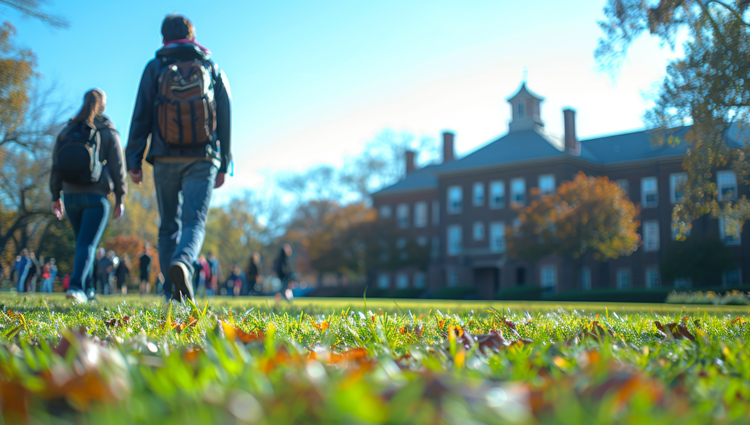
Students walking across a university campus on a bright autumn morning toward a historic academic building with sunlight.

Restoring True Diversity

At one of America’s most elite universities, I expected open debate and fearless inquiry. Instead, I found silence—an unspoken rule that Christian thought belongs behind closed doors. This essay exposes how elite campuses celebrate diversity while quietly excluding faith from intellectual life. It’s a call for universities to rediscover real inclusion—where Christian voices aren’t merely tolerated, but respected as essential to understanding truth, human dignity, and the moral foundations of education itself.

Read More »
>