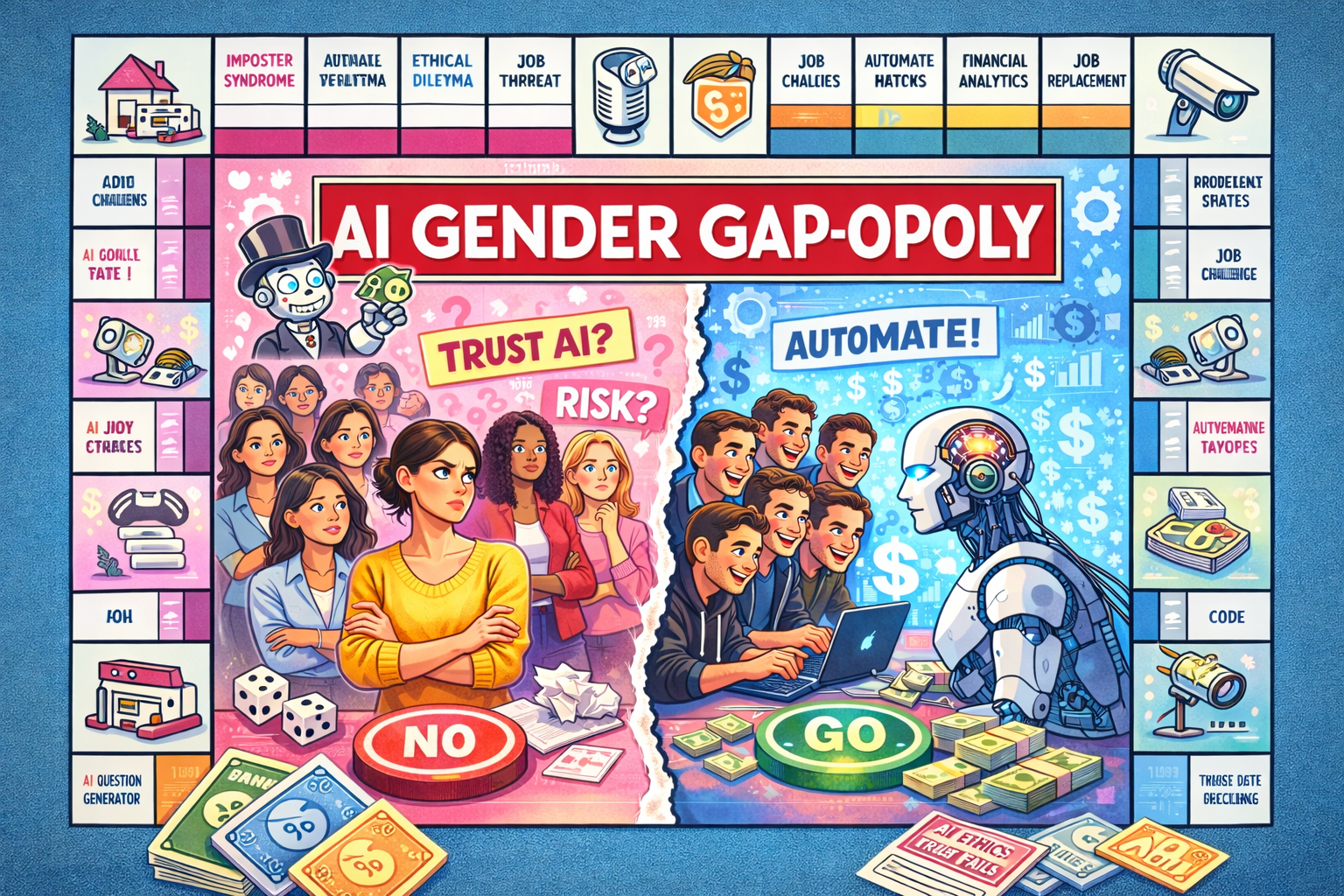
We talk about the gender gap in the workforce–everything from leadership to ambition and opportunities–as well as the empowerment and reproductive health gender gap, but the newest gender gap? And perhaps the gender gap with the most startling implications? Artificial intelligence.
The AI gender gap isn’t about access–it’s about discretion. On a global scale, women are reluctant about AI usage, leading to a potentially catastrophic “self-reinforcing cycle”, where women are less familiar with these systems that will–for better or worse–be used in the workplace, and these systems, as they learn and adapt, don’t learn equally about women.
In February 2025, Harvard Business School’s Michael Blanding published a frightening article, distilling those findings into a few implications for women in the workforce. If this gender gap continues, women could struggle to advance in their careers; the economy could suffer; AI could not learn about women.
For working women, all these “coulds” should instill a sense of urgency, right? The risk of falling behind should impel women to give up their ethics and worries and swim into the AI sea. But women are concerned, and rightfully so. Researcher Rembrand M. Koning–the man whose working paper jumpstarted the AI gender gap conversation–said that women are worried about the ethics of such technology, asking questions such as, what does it mean to rely on computer-generated information?
Before we call on women to embrace AI, we should first ask, why are women such skeptics? Is there some gendered wisdom we’ve overlooked in our pursuit of progress? First, let’s examine what the tech industry has to say about women and generative AI usage.
The Women Who Want You To Use AI
Tech oligarchs think positively about generative AI. (Shocking.) Their advice: embrace it! Why? Well, there’s no way around it.
Just last week, Sheryl Sandberg–an acclaimed tech billionaire who served as Facebook’s COO for nearly 15 years–spoke on CNBC on AI’s implications for women. “What happens in this moment for our workforce is so critical,” Sandberg said. “…Men are more than 50% more likely to be encouraged to use AI by their managers.”
This stat–straight from the 11th Annual Report on Women in the Workplace–refers to entry-level jobs, where men are 50% more likely to receive the go-ahead to use AI. The implication? Men advance further, automating tedious tasks, leaving women in the dust. Sandberg’s advice to women? You got to use it.
“This is critically important technology,” Sandberg said. “Use it…everyone watching, get your daughters to use AI tools.”
Like many women, I find myself acutely aware of AI’s looming presence and capabilities, but I want to avoid it. Is this skepticism ignorant, or is it intelligence? Let’s be honest–this tech revolution doesn’t feel like any that’s come before. We’ve all seen thrillers that begin with AI’s encroachment into humanity, and the ensuing apocalyptic endings where humans rue the day they let this technology into their daily lives.
Skepticism Is Our Strength
I want to make one thing clear: refusing AI isn’t ignorance. It’s intentional judgement. Why are we so skeptical? Are we better off for it? I have a few ideas, and forgive me, many of these ideas are grounded not in research or working papers, but general wisdom and consensus about biological gender gaps.
- Women think critically more regularly. We know men and women are from two distinct planets, and part of this wiring means that women tend to ruminate more. We tend to replay things, think about our emotions, and talk about them. We let problems take up more space in our heads than men do (on average.) As a result, we revisit conversations, failed interactions, etc.– In terms of AI usage, this means rejecting quick, temporary fixes to problems that require not immediate answers, but rather, careful deliberation.
- Women are more creative. Women dominate creative professions. The cliché goes, women are better at English, while men excel in math. Writing, poetry, cinema, art, and other creative sectors face heinous attacks. In these fields, where nuance, empathy, and storytelling is valued, AI can’t keep up; nonetheless, creativity is under assault, as more than two-thirds of workers in creative industries feel as though AI has undermined their job security. Unsurprisingly, in 2023, 99% of Writers Guild of America voted in favor of demands to regulate AI, in the hopes of preventing the displacement of screenwriters. In this sense, where AI supporters see progress, women see the loss of originality, creativity, and the humanity that stories require.
- Women value emotional intelligence more than men. This goes back to point number one–women are thinkers. AI can mimic language, but not understanding. Women–by virtue of our ability to emotionalize better, especially when it comes to managing relationships, families, and friendships–don’t see AI as filling in the gaps. They see generative AI as creating a gap between feeling and automation. Women, more clearly, see that AI attempts to outsource our shared humanity.
- Men tend to look for shortcuts. I hope my male readers don’t take offense to this, because it isn’t necessarily a diss. These shortcuts have spurred innovation in all departments, and when women look for methodology and a step-by-step process, men look for how to speed it up. AI offers speed-ups without accountability. Think about it–where women might look for feedback from another individual, men would rather save time and resources and ask the computer. The result might not be as great, but it saves time, and time is… you guessed it… money.
- Women don’t fall for the promise that technological innovation is undoubtedly progress. This is perhaps the most important reason of all–women uniquely have the foresight and wisdom to see that the rise of generative AI is not synonymous with progress and prosperity. Women understand that technological innovation involves downsides, and in this case, extreme downsides.
Some of those downsides? Increased electricity demand and water consumption, alongside other environmental impacts. There’s less human decision-making; we’re listening more to algorithms to decide everything from what show we want to watch to who we date. Job insecurity rising at record rates, a frightening capacity for AI-generated news to influence public opinion.
But, why don’t we go straight to the source on why more women are anti-AI? I asked Chat GPT for five reasons why women are so reluctant to use AI compared to men. Here they are:
- Women are punished more for mistakes, and AI is built on trial, error, and visible failure.
- AI rewards speed over care, while women are expected to prioritize accuracy, judgment, and responsibility.
- Women anticipate accountability, asking who bears the blame when AI gets things wrong.
- AI threatens work women already struggle to have valued, making adoption feel self-undermining.
Women’s distrust of “neutral” systems is learned, not irrational, after repeated institutional failures.
Where Does This Leave Us?
Are women going to damage their career prospects by refusing to accept artificial intelligence? Are women risking success in favor of moral superiority? These are questions that female AI skeptics have to contend with.
Mara Bolis at the Stanford Social Innovation Review seems to disagree with us AI virgins. She agrees that our skepticism is well-founded, but she also agrees with the experts that women 40+–at the height of their professional careers–must embrace AI so it doesn’t “tilt even further male.”
“Opting out of generative AI is about as realistic as opting out of electricity or the internet,” she wrote. “We should use generative AI to empower ourselves and others, and we should demand exacting standards of transparency, fairness, and safety from those building and governing these tools.”
Bolis’ vision of AI is one that I would like to agree with. I would like to agree that we–our institutions and our checks and balances–have the power to regulate AI and craft guard rails that, as every politician puts it, don’t stifle innovation but ensure human safety. But Bolis’ balmy vision is nearly impossible, given the rapid progress of this technology. Alarms sound months, even years, after these technologies are already making us breakfast and pouring our coffee; this inability to regulate AI means an inability to hold AI accountable.
Why should we fully embrace a technology that we can’t stop? Asking women to embrace AI might just seem like asking us to invest in ourselves and our career goals, but it’s also asking us to give up one of the last slivers of our humanity in a technology-ridden, ever-changing world.
Don’t Give Up on Humanity.
I want to leave like-minded women with a battle-cry. As any expert will tell you, this technology is critical; we’re at a turning point in our AI acceptance that dictates what we want our future to look like. Giving into AI is not just about maintaining job security or keeping up with the newest trends.
It’s about speaking up against this assault on our humanity. Where men jump into the deep end, proud of their ability to take risks headfirst, women linger on the sidelines–and for good reason. Be confident in your doubts, in your worries, and your reluctance to embrace this technology. It’s not a character flaw–it’s an asset.
There is nothing naive about caution. Caution is our strength, in an era of quick, impulsive decision-making and outsourcing thinking. Use it.